AI got better. Our confidence got worse. The gap was never the technology.
THE VERDICT
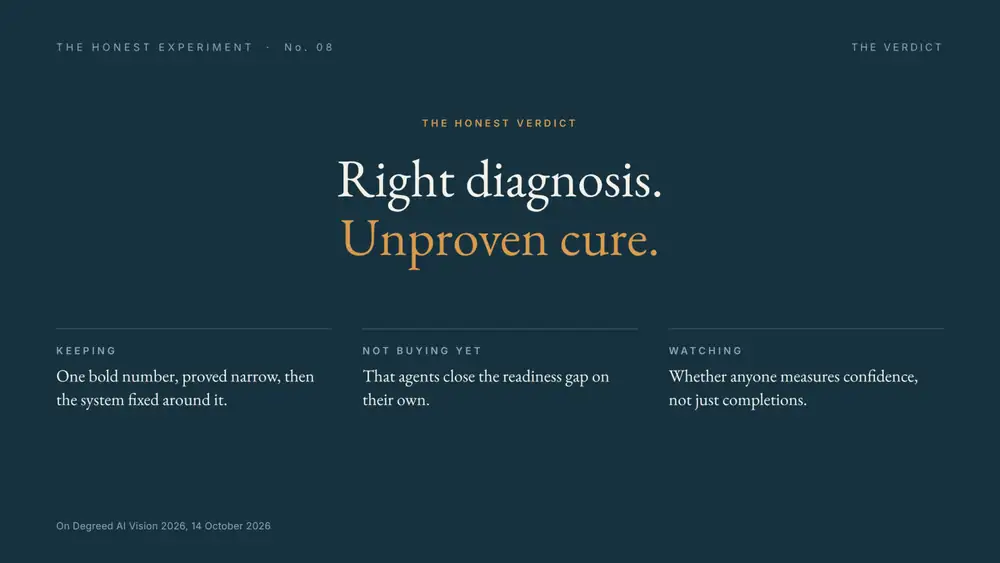
Right diagnosis, unproven cure. Degreed AI Vision 2026 named the real problem: AI’s missing return is a people-readiness gap, not a technology gap. Executive confidence in human–machine teaming fell from 65% to 51% while the machines got better, and most attendees rated their own ability to build an AI agent at 1 out of 5. The agents on show are impressive; what is still unproven is whether they close that readiness gap, or simply run faster on top of it.
Evidence base: Degreed AI Vision 2026, a fifty-minute virtual event on 14 October 2026 with nine speakers, attended live. Figures are as presented on stage, including Marsh’s annual survey and Degreed’s pre-event attendee poll. For: L&D and HR leaders weighing agentic learning platforms, and the executives being asked to fund them.
I don’t go to vendor sessions for the pitch. I go for the problem.
For nearly a decade I’ve worked across L&D, HR, skills and workforce intelligence, on both the processes and the technology behind them. I’m a technologist at heart, so I’ll gladly give an hour to a product keynote. Not to hear what’s being sold, but to learn what the people building it believe is broken. That tells you more about where our profession is heading than any roadmap slide.
On 14 October that hour went to Degreed’s virtual AI Vision 2026. Fifty minutes, nine speakers, one big claim: AI’s missing return is a people problem, not a technology problem.
I think they’re half right.
So here is my honest read: what I’m keeping, what I’m not buying yet, and the questions every L&D and HR leader should ask before signing up for the agentic future. You’ve sat through these sessions too. You’ve nodded along to the roadmap. This is the version without the applause.
The hook
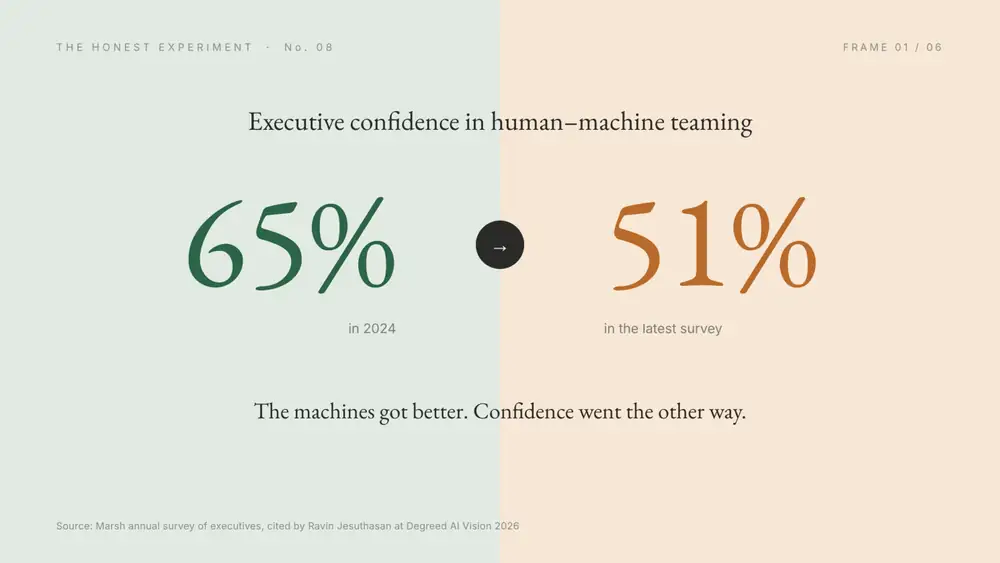
Confidence in human–AI teaming is falling while AI is getting better.
Evidence: Marsh’s annual survey of executives, HR leaders, investors and employees. Executive confidence in human–machine teaming fell from 65% in 2024 to 51%, over the same years that machine capability rose sharply. Said by: Ravin Jesuthasan, Marsh, in the fireside with David Blake.
I’ve heard this number at more than one event now, so I won’t argue with it. But I don’t read it as bad news. 65% was the confidence of early excitement, when AI was a demo and not yet a deadline. 51% is what happens when the real work arrives. Practical sense is replacing the honeymoon, and the true numbers are finally surfacing.
My prediction: it dips further before it climbs. And when confidence does come back, it will be earned in redesigned work, not bought with new tools.
The 1-out-of-5 problem
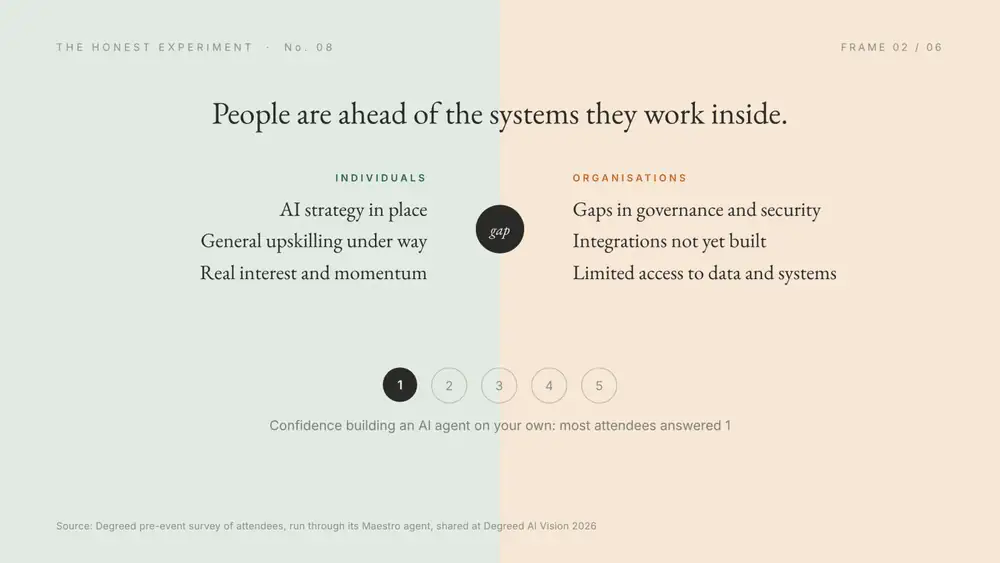
Degreed surveyed attendees through its Maestro agent before the event — a narrow sample, but an important one. Most organisations have an AI strategy, and general upskilling is under way. Asked how confident they feel building an AI agent on a 1-to-5 scale, most said 1.
What they really want: hands-on practice, templates, mentors, and real work to apply it to. The bigger gap was organisational: governance, security, integrations and access to quality data.
David Blake named the gap I see most often between a promising start and real success: individuals are ready before their organisations are. People bring the curiosity and the early skills, then hit the wall around them — governance, security, integrations, access to data.
I’ve seen that gap narrow over recent months. It hasn’t closed. It is still one of the biggest thorns in our side, because no amount of individual upskilling helps if the organisation isn’t ready to let people use what they’ve learned.
Redesign the work, not just the tools
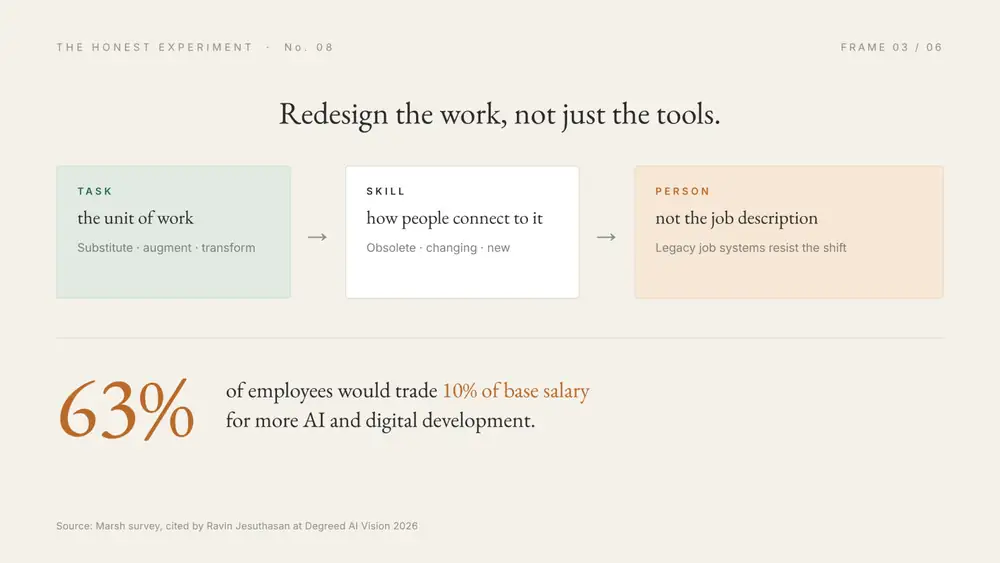
Tasks are the unit of work. Skills are how people connect to it. Yes, we have all heard it repeatedly. But that is fine: it is starting to be said in the same, standard way, rather than everyone coming up with their own version. I am taking that as a win.
For three to four years, organisations led with the newest model and broad access. The real obstacle is redesigning the work: where technology substitutes, augments or transforms tasks, and which skills become obsolete, change or are newly needed. Legacy job and job-family systems are proving hard to move. Yet 63% of employees in the Marsh survey would give up 10% of base salary for more AI and digital development (Ravin Jesuthasan, Marsh).
Honestly, I twitched when I heard this one. I understand the emotion behind it: people can see their work changing and want to keep up. But with my pragmatic hat on, I wouldn’t give up an inch of my salary, not while organisations are cutting roles the way they are. Ravin is my next call to dig into this number. That’s me.
Would you take that trade if it were on the table?
Bold, prototype, scale
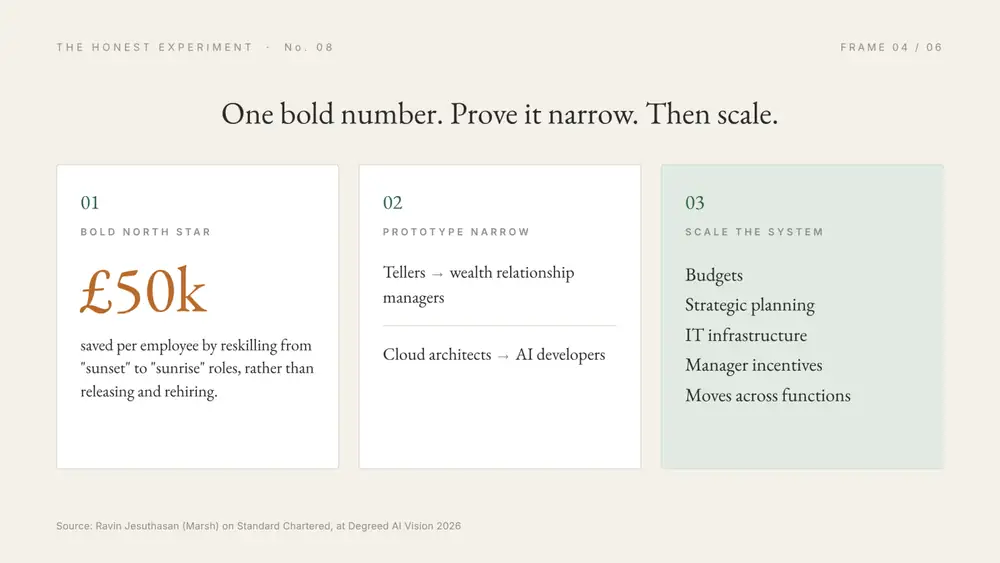
Start with one bold number, then prove it narrow before scaling. What is your bold number? Marsh sees three steps in the organisations doing this well:
- Set a bold North Star over several years — 40–50% labour capacity release, or 35% productivity gains, not 3–5%.
- Prototype quickly in narrow zones, and prove it.
- Scale by fixing the systemic enablers: budgets, planning, IT, incentives and talent moves across functions.
Standard Chartered began by showing its board it could save £50,000 per employee by reskilling from “sunset” to “sunrise” roles, rather than releasing and rehiring. Prototypes moved tellers into wealth relationship managers, and cloud architects into AI developers. Ravin cited total shareholder return above 330% over four years.
Evidence: Ravin Jesuthasan, drawing on The Skills-Powered Organization, co-written with Standard Chartered’s Tanuj Kapilashrami.
Agents for every persona
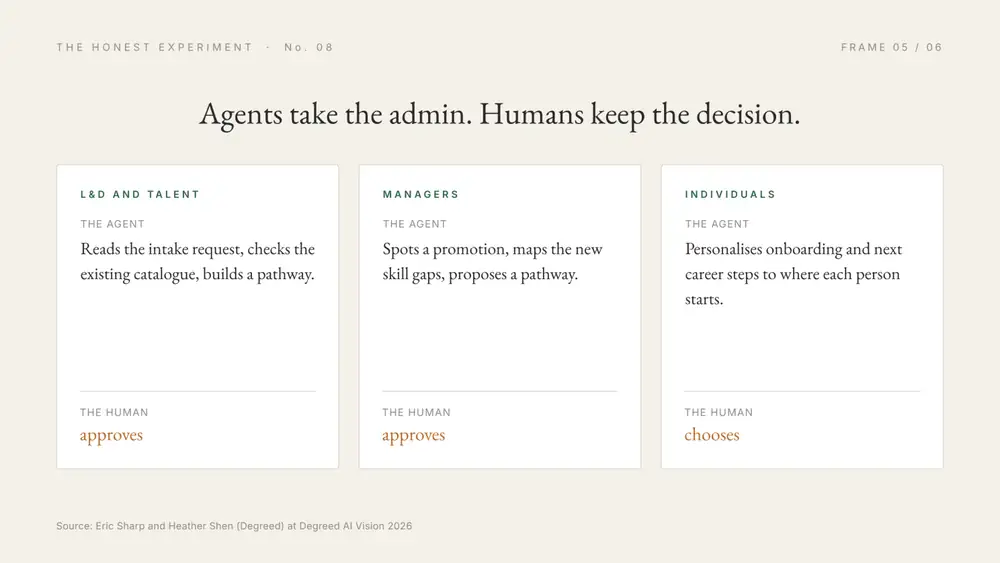
Agents take the admin, so people can do the strategic work. Eric Sharp, Heather Shen, Elizabeth Tan Levy and Taylor Blake each shared how Degreed’s AI Experience and AI Intelligence work aims to help organisations do exactly this.
- Four foundations (Eric Sharp): context (who someone is and how they learn), tools, agents and their skills, and the underlying data.
- L&D (Heather Shen): an agent reads an intake request, checks the existing catalogue, builds a pathway, and the admin only approves it.
- Managers: ask an AI assistant what the team’s skills look like; an agent spots a promotion and proposes a pathway for the new skills.
- Onboarding: one client with 35,000–40,000 new hires a year on a five-week programme is personalising it to shorten time to productivity.
- Roadmap (Liz Levy): guided conversations, adaptive pages, multi-persona role plays with up to four personas, enterprise administration with access controls, and a capability data pipeline.
- Demo (Taylor Blake): an agent compared a new code of conduct with old compliance training, built test-out assessments, added formats, translated, ran QA and exported to SCORM.
Degreed is building its AI Experience and AI Intelligence layers around its existing platform and products. The results look appealing, but they are built from the inside out.
Fourteen years of skills data is a real asset. Still, an agent is only as good as the data it reasons over, and in many organisations skills data is patchy, self-assessed and out of date. Put agents on top of that and you personalise the wrong thing faster.
The harder problems sit outside any one platform: governance, data access, and the systems where work actually happens. Phillips 66 said it themselves: their AI Central can’t yet talk to their Learning Central.
So my question for every vendor in this space is simple: what does your AI do when the data it needs lives somewhere else?
The best evidence was human
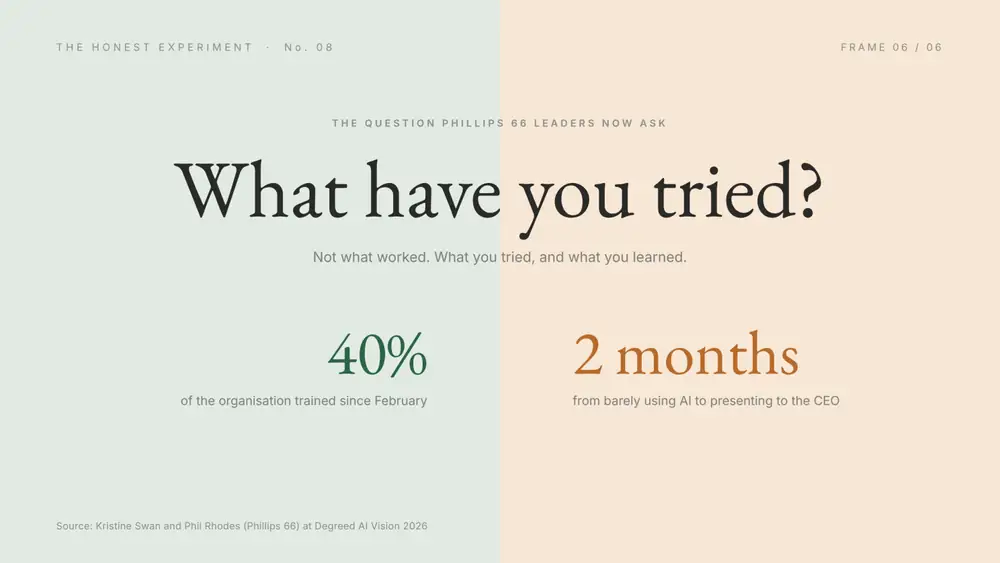
Not “what worked?” but “what have you tried?” — Kristine Swan and Phil Rhodes, Phillips 66.
Phillips 66 named three enterprise-critical skills with its executive team: AI, continuous improvement and business acumen. It runs Learning Central (Degreed) beside AI Central, its internal AI platform for search, chat and building agents. 40% of the organisation has been trained since February, with adoption tracked on a dashboard. One AI champion who had barely used AI was presenting to the CEO within two months. HR and digital teams now plan together, and leaders ask teams what they have tried and learned.
Phil also shared their plan for next year: connecting AI Central and Learning Central agent-to-agent, within their AI governance, so career conversations turn into real learning. Time will tell, but the foundations laid at Phillips 66 look strong, and the results are speaking for them.
Closing points
Something David Blake said stuck with me:
“Organisations only move as fast as their people.” And: “It is hard to move people forward if you don’t know where they are.”
Every speaker on that stage described a future I’d like to work in. Agents that take the admin. Learning that meets people where they are. Confidence that is earned, not assumed.
But a roadmap is a promise, not a result. So before your next keynote, sit with three questions:
- Where is your organisation on that 1-to-5 scale, honestly?
- Which of your job descriptions would your employees still recognise?
- What have you tried this year, and what did it teach you?